

Start with the task behind the request
“We need an easy approval system” sounds clear until the team has to decide what “easy” means. Who approves? What are they approving? What should happen when the request is incomplete, the approver is away, or the person submitting it has no authority?
Consider this fictional East African wholesaler asking for approval of purchase requests. It is an example for discussion, not a client project. The same commissioning questions can help organisations across English-speaking Africa, the UK and elsewhere. Confirm local data, contract, integration, regulation and delivery-coverage questions for the actual project.

Name the business owner who can decide whether the expected result is acceptable.
Describe observable behaviour
An operational requirement can name the actor, the situation or trigger, the action they may take, and the result they should see. Add at least one denied action or exception. A sponsor can review these statements in everyday language; the delivery team can later translate them into design and tests.
For example: “When a branch buyer submits a complete purchase request above their delegated limit, the system sends it to the assigned manager. The manager can approve or reject it. The buyer can see the decision and its date. A buyer cannot approve their own request.”
Now ask what counts as complete, how the limit is set, and what happens if the manager’s account is inactive. Those may be requirements, policy questions or open decisions. Record who will answer each and by when. Do not let the software team invent a business rule because a field was left blank.

Describe behaviour so a sponsor can assess the result without writing code or dictating a screen.
Add examples around the boundary
Use a normal case, a denied action, missing information and an interrupted task to expose ambiguity. For example:
- Normal: an authorised manager approves a complete request within their limit; the buyer can see the outcome.
- Denied: the buyer attempts to approve their own request; the system does not record an approval.
- Missing information: the submitted request lacks a supplier; submission is blocked and the missing field is identified.
- Interrupted: the manager loses connection before submitting a decision; the request remains pending until a confirmed decision is saved.
The business owner must confirm each rule. If the policy is undecided, label it as an open question instead of presenting the example as an approved rule.
Separate the result from the preferred screen
“Put the approve button at the top right” is a screen preference. “An authorised manager can record an approval, and the requester can see who decided and when” describes business behaviour. A layout preference can still matter, especially for accessibility or a required work context, but it should be identified as a design constraint and reviewed separately from the outcome.
Connect each requirement to an acceptance example and name a business approver who can judge whether the result meets the need. Microsoft’s Dynamics 365 testing guidance recommends business-process testing and stakeholder sign-off in its implementation context; it is useful commissioning guidance, not evidence about a Chwezi or other product. Microsoft Learn: Dynamics 365 testing strategy

Agree the evidence and approver before the team treats a requirement as complete.
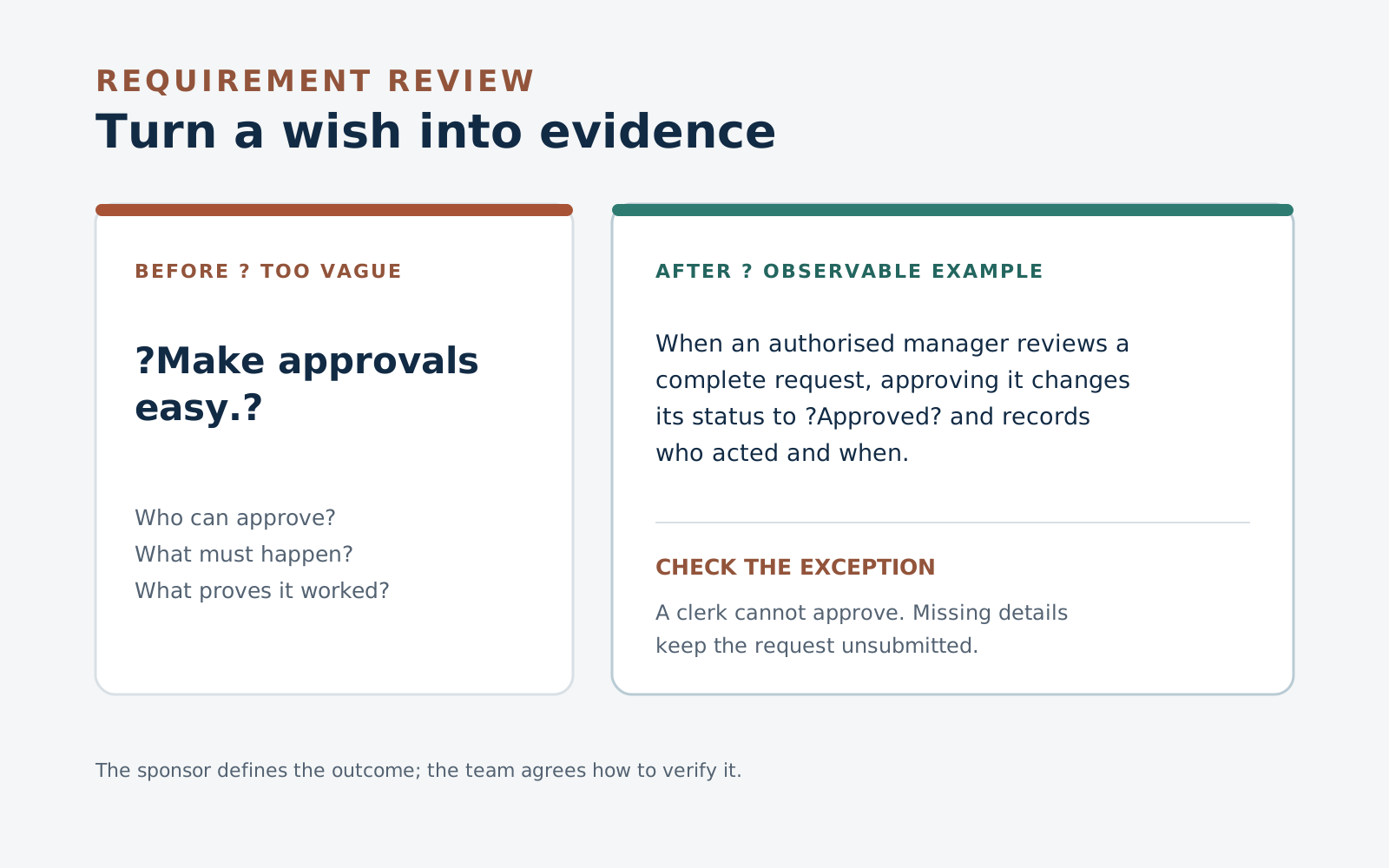
Put the expected behaviour beside an example that the business owner can accept.
Requirement card
Use one card for each requirement in the software requirements document, or SRS, that needs a decision or acceptance check. Keep unresolved points visible as scope changes.
| Field | Example |
|---|---|
| Actor | Branch buyer; assigned manager |
| Need | Submit a purchase request and receive a recorded decision |
| Business reason | See whether the request may proceed |
| Example | Complete request above limit routes to the manager; decision and date are visible |
| Exception | Buyer cannot approve their own request; missing supplier blocks submission |
| Acceptance evidence | Demonstrate normal, denied and incomplete cases with agreed test data |
| Business approver | Named purchasing owner: __________ |
| Open question / owner / due date | Who maintains delegated limits? __________ |
“Acceptance evidence” might be a witnessed demonstration, test result or inspection, depending on the project. Agree what is sufficient before delivery and keep the decision record with the requirement.
Chwezi’s intended requirements-first method
Chwezi’s internal SRS method is intended to clarify requirements, decisions and acceptance evidence before implementation choices are fixed for custom-development work. This describes the intended method; it does not establish that every historical project retained a complete evidence pack. Chwezi’s public technology page describes its services but is not independent proof of delivery results. Chwezi software development
Ask Chwezi to turn one uncertain requirement into a testable example. The example and card here are editorial tools, not a guarantee of a particular delivery process or project outcome. Proposed related reading: Buy, Configure or Build? and Find the handover that keeps failing.
Sources and scope
IREB’s CPRE Foundation Level handbook and the ISTQB Acceptance Testing syllabus discuss clear, verifiable requirements and criteria that focus on the intended result. The examples above are fictional editorial synthesis. No search-volume, ranking or measured project-success claim is made. No jurisdiction-specific law, contract term or data rule is prescribed.